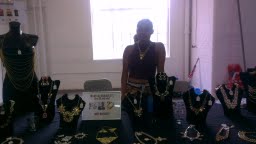
"I'm going to go to their offices, because whenever I hand out the CV nobody replies or they say ‘no’. So if I meet them face to face, I can blag my way in."

Toyin Owoseje | Proving Persistence Is The Key, Wrench and Bulldozer For Unlocking Opportunity’s Door

Feature Post Of The Week

In Her Words |

Principle 2:
The Beloved Community
is the framework for the future.

Dr. Martin Luther King, Jr |
Six Principles of Nonviolence

"

Food-For-Thought

social integration | soh-shuh l in-ti-grey-shuhn |
n.
"the blending and unifying of social groups, most commonly seen in the desegregation of races throughout history"

Yaaya asks:

To what extent do you feel social integration
for European black women has been achieved in the nation you live in?

?

Join The Conversation

Yaaya Asks About | Social integration for black women in Europe and for European black women globally

Showing posts with label events. Show all posts

Sunday, December 08, 2013

Yaaya At: The Film Africa Festival 2013 | L'Afrance

"50 years ago, they said 'n**gas are savages who can play drums.'

Today they say, 'black people have got rhythm.'

I am sick of being black.

I am a Senegalese."

With these words, L'Afrance sets the tone for the unfolding of an emotional journey in search of the answer to that most fundamental of existential questions "who am I?" Director Alain Gomis' debut piece, L'Afrance encapsulates the psycho-pathological struggle of the European migrant through the story of El Hadj, a young, talented student, whose swift fall from grace to grass is as surprising as it is saddening, leading him on a road to self-discovery.

In this gripping drama, a young West African man finds himself wrestling with his dreams and identity. El Hadj Diop (Djolof Mbengue) is a student from Senegal who has almost completed his studies at a university in Paris when he discovers that he has neglected to renew his residency papers. This negligence brings him face to face with the full force of French immigration authorities, who arrest, detain and plan to deport him. Desperate to find a way to stay in France long enough to graduate, El Hadj arranges to purchase forged immigration documents, and takes a job with a construction crew in order to pay for them.

On a personal level, El Hadj is faced with marriage on his return home to his long-term fiancée, Awa. He evades this by choosing to remain in France rather than submit to the immigration laws and ultimately, deportation. He spends his days navigating Senegalese life via the tapes he is sent from home, and negotiating demanding phone calls from his future wife, while also experiencing French life via football matches, wedding parties and police abuse. Cultural conflicts catalyze to lead him to a turning point of violence, and attempted suicide. The film ends with El Hadj post-breakdown back in Senegal, and in an unlikely 360 degree turnaround, informing his father that he wishes to stay in France and teach there instead.

Alain maintains "this is not a film about immigration." Rather, L'Afrance is an attempt to highlight that "identity is not just about nationality." Nonetheless, he adeptly captures the migrant experience of European society, on a multi-layered fabric. From El Hadj's character, representing the best and brightest of youthful Africa, a highly skilled migrant on whose shoulders rest the hopes of entire peoples, to Demba, a hardworking older friend of El Hadj’s, who has lived so long on the fringes of French society that he had become invisible. A fifteen-year exodus from Senegal turned to, some may say self-inflicted, exile. Forever lost to the warm touch of his wife and his son's loving embrace.

We watch as our protagonist, a confident, intelligent young man is reduced to little more than a raving pugilist; a cement carrying barroom brawler. We see his railing struggle against this transformation, where Senegal, black consciousness and fiancée Awa represent the old and familiar; and France, socio-cultural integration and Myriam, his white lover, represent the new and invasive.

Djolof Mbengue pulls off the portrayal of this charismatic eccentric with style. From a dignified confidence reminiscent of past prides of Africa (Sekou Toure, Patrice Lumumba) to a raging madness characteristic of a trapped lion in a desperate fight for freedom, and finally, to a quiet, calm acceptance of the inner knowledge that he is no longer that which he once was. El Hadj neither abandons his prior upbringing completely, nor embraces his new identity entirely. Instead, he morphs into a hybrid; a confluence of cultures: where Western Africa meets Western Europe ...

L'Afrance is raw, real, passionate and potent. It sheds a light not only on the legal and socio-cultural implications of migration in European society, but also on its lasting psychological effects; the feelings of displacement, of disconnect and detachment from what was once El Hadj’s sole source of identity, his Senegalese background, now reduced to little more than fond memories. In an increasingly global society where immigration and expatriation are fast becoming the norm, L'Afrance is relevant and timely in forcing us to ask: ‘as human beings, what constitutes our identity, and in this context, how do we define ourselves?’

Source | Images courtesy of L'acid and Toutleciné. Video courtesy of YouTube.


Friday, December 06, 2013

Yaaya At: The Film Africa Festival 2013 | La Pirogue


Two hundred years ago, the people of Senegal, like many of their West African neighbours, experienced the greatest human rights abuse of all time – the trans-Atlantic slave trade. Wolof, Fulani, Halpulaar and Serer people were captured and chained in slave ships for three months, where only the strongest survived the middle passage, only to be sold like cattle in the Americas. 200 years later, hundreds of Senegalese young men are ironically embarking on the same dangerous journey across the Atlantic, but this time by their own free will, and on fishing boats as opposed to slave ships.

These disturbing ironies, despite their slight nuances, were one of our first thoughts upon reading the synopsis, and watching the film in its entirety. History and current events seem to be intertwined and difficult questions such as: upon the millions of Africans whose bodies lay on the bed of the Atlantic Ocean as a consequence of the slave trade, how many more now lay afresh with their ancestors in this day and age?

La Pirogue

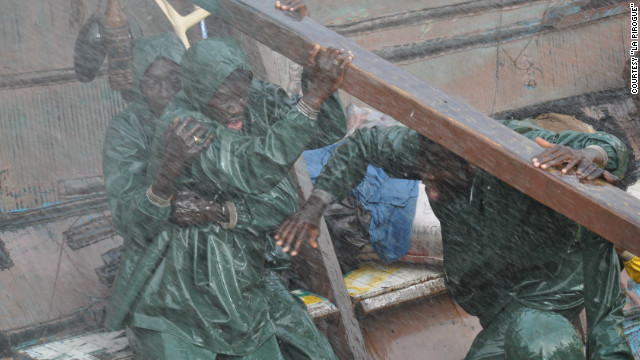
La Pirogue tells the story of an experienced fisherman and family man named Baye Laye (Souleymane Seye Ndiaye), who is ‘coerced’ into using his expertise to captain a pirogue filled with 30 Senegalese and Guinean individuals- some of whom have never seen the sea before. Their destination is Spain, and Baye Laye initially struggles with the temptation and pressure to embark on this dangerous journey, but later gives in as economic pressures, moral sensibilities and the desire to realise his own hopes prevail.

The Dakar-based smuggling operation appears to be a smooth and common business, as financial transactions and deals are swiftly closed, and a steady stream of willing and hopeful men are plentiful. Before the pirogue even sets sail, we see how tenacious young men desire to leave Senegal through the characters Abou (Malaminé 'Yalenguen' Dramé) and Kaba (Babacar Oualy), who enviously highlight the names of their peers who have left Senegal and built luxurious homes, and those in successful musical bands. They harbor naive expectations of becoming a professional footballer and a music producer once they land on European shores, which causes the audience to feel pity on their child-like, yet understandable gullibility.

As the pirogue and its passengers embark on their journey, we initially see minor tensions across ethnic and linguistic lines, bullying from Lansana (Laïty Fall) the middle man of the smuggling operation, and friction caused by the discovery of a female stowaway named Nafy (Mame Astou Diallo). However as the journey lengthens, we begin to see friendships form, tension and rivalry lessen, and support between brethren strengthen. The first couple of days on the pirogue appear to be fine. Baye Laye is doing an excellent job of navigating the Pirogue, food, power and health are in good measure, and they seem to be making steady progress towards their destination. However, there is an overwhelming sense amongst the audience that this good fortune will not last for long. This foretelling is particularly illustrated when the pirogue encounters another boat whose passengers are stranded without food or fuel. The crew’s faith is tested, and they decide not to rescue the destitute passengers, which marks their ominous fate on the high seas of the Atlantic.

Almost predictably, their boat is caught up in a deadly storm, which cements in the minds of the characters and the audience that their fortunes have turned, and that a precarious situation lays ahead of them. The storm is the crew’s first experience of death and misery, which causes fear, insecurity and an increase in prayers and exhalations to God amongst the passengers. Soon after the storm, the pirogue’s engine gives in, and we tragically see passengers perish one by one, as food and water diminish, and thirst, exhaustion and exposure to the elements claim the lives of the old and young.

When it appears that there is no hope left, we are exposed to the inner thoughts of some of the last remaining passengers as they reflect on their lives, decisions, families and God, before they too expectedly die. Just when it seems like the last survivors will perish; the Spanish Red Cross discovers the Pirogue, where only 4 passengers remain. They are rescued, however sent back to Senegal, where they receive a mere sandwich on their arrival. As Baye Laye and Abou walk home together from the airport, we question if they think their decision to cross the Atlantic was worth it, and what lessons they have learnt about themselves.

The film ends with a dedication to the 300,000 West Africans that have perished as a result of crossing the Atlantic to greener pastures in Europe, a jarring figure which Moussa Touré puts into context by providing human faces, an emotive storyline, and infallible dreams.

Source | Images courtesy of Covering Media, Rue89, CNN. Video courtesy of YouTube.


Wednesday, December 04, 2013

Yaaya At: The Film Africa Festival 2013 | Atlantiques

There was a noticeable buzz inside Ritzy Cinema in Brixton, as we waited for the screening of Atlantiques and La Pirogue. No doubt the Yaaya team was riled up to see both films, not least because it quenched our love for the arts, Africa and the African Diaspora, but because the Film Africa Festival had succeeded in putting together an exciting and diverse exhibition of films and documentaries from across Africa.

These films encompassed brilliant works of cinematography from Anglophone, Francophone, and Lusophone Africa, displayed the cultural and linguistic diversity of the continent, whilst at the same time explored the intersectionality of Europe and Africa in the context of migrant experiences and aspirations.

It was the exploration of the experience of African migrants, and their imagining of Europe as an economic haven where choice and dreams can be realized, that instinctively prompted us to watch both films. Yaaya, being an organization that in addition to providing a platform for black women in Europe to share stories of success and ambition, also endeavors to start conversations in relation to the black experience in Europe. Atlantiques and La Pirogue therefore provided us with an opportunity to see both a documentary and dramatization of pertinent issues that concern us.

As we took our seats, tweeted, found the time to take pictures and completed bureaucratic paperwork, we were welcomed by the facilitator for the night, and pleasantly received a talk from the Head of the IOM (International Organisation for Migration) in the UK, where she put into context the current reality of the dangers many African migrants face when crossing the Atlantic to enter Europe. As the lights dimmed, and the movie theater quieted, we experienced two powerful pieces of work, which forced us to ponder the extent to which an individual’s life can become so difficult that risking death becomes a viable option, and question how Europe can effectively manage a natural human occurrence.

Atlantiques


Atlantiques is a short documentary which explores the motivations of a young Senegalese man named Serigne, who wants to leave Senegal on a pirogue (Senegalese fishing boat) en route to Spain for the second time. The documentary opens with a recording of a man describing his experience of boarding a pirogue, and he gives a harrowing account of his near death experiences on the Atlantic. The recording sets the tone for the rest of the documentary, as the audience watches and listens to a series of conversations in Wolof between Serigne and Alpha, two young men who have different views about risking one’s life to enter Spain. Serigne states that “he has nothing but dust in his pockets,” and reveals his frustration of not being able to provide for his family who experience hunger because of a lack of money.

Serigne’s frustrations mirrors that of many young Senegalese men, in a country with an unemployment rate of 48% as of 2007[1], which has consequently forced many young men to leave villages, towns and cities in search of brighter futures abroad. We see Serigne rationalize his decision to cross the Atlantic a second time, with justifications such as “If I die its God’s will,” an illustration of how fear, risk and hope co-exist in the minds of would be migrants. Alpha on the other hand doesn’t view the risk as worthwhile, and tries to discourage Serigne from boarding a pirogue again. There are however points of agreement between the two young men. Alpha is equally aware of why Spain is an attractive place for his friend, and listens intently as Serigne reveals the psychological impact that his first trip has had on him, and how he has experienced things “he cannot speak of.” The two men also ponder on what action they would take in difficult scenarios on a pirogue, such as if a friend happens to go overboard. Serigne argues he will try and help his friend even if it means risking his own life, illustrating how friendship and support is an important part of surviving the voyage, but also how men are bought into one another’s hopes, dreams and desires.

After the series of conversations between Serigne and Alpha, we soon learn that Serigne died on his second attempt to cross the Atlantic, and in turn that he did not heed the advice of his friend. We see the impact Serigne’s death has on Alpha and his family. As an audience we also feel his loss. This is because we have been privy to his intimate thoughts and feelings with his friends, and have sympathised with his frustrations. Serigne is now a statistic with a human face, part of a group of over 300,000 hopeful West Africans who have perished trying to cross the Atlantic.

A memorable part of the documentary is when the camera focuses in on who we presume to be Serigne’s sister for a long period of time who is visibly upset. The setting is inferred to be Serigne’s family home, and we get the sense that his family is mourning his death. This scene reinforces the impact of the death of young men on families, and forces us to question how many families have lost multiple sons, grandsons, husbands and nephews on this treacherous voyage.

Source | [1] “The World Factbook, Unemployment Rate". Image courtesy of Film Festival Rotterdam. Video courtesy of Film Africa IDENT from Film Africa on Vimeo.


Thursday, August 15, 2013

Yaaya At: A Season In The Congo | Lumumba. Hero. Martyr.

A Season In The Congo
Lumumba. Hero. Martyr.

BAFTA Award winning director Joe Wright (Anna Karenina, Atonement) directs Olivier Award winner Chiwetel Ejiofor (Amistad, Children of Men, Dirty Pretty Things) in this spectacular retelling of one African country’s struggle for its sovereign right to self-determination.

Pulsing with music and bursting with evocative dance choreography, this scintillating piece of physical theatre charts the rise and fall of legendary independence leader Patrice Lumumba, whose passionate determination to free his people from Belgian rule inspired great courage and betrayal.

Though it depicts the story of one nation in one time and place, A Season in the Congo mirrors the fight of many an African nation and its leaders, for freedom from colonial rule and the inherent right to self-determination.

A farmer’s son, Lumumba led his people to independence from Belgium, and became the first democratically elected leader of post-colonial Congo in 1960. He served for less than three months. By January 1961, Lumumba was dead – shot in murky circumstances that involved the Machiavellian future dictator Joseph Mobutu (Daniel Kaluuya) and international foreign powers.

Once described as a “beer salesman who sold dreams to a nation of children”, Lumumba’s Pan-Africanist ideals were no match for the intricacies of political power that surrounded him. Chief among them was the secession of the mineral-rich Katanga, a crafty ploy by the Belgians to swiftly return the Congo to colonial rule.

Chiwetel Ejiofor sizzles on stage as the legendary persona. Portraying this freedom fighter requires a combination of seemingly juxtapository characteristics: an easy amiability that endears him to his countrymen, balanced by fiery oratorical power that incites passion and anger in the Congolese. It demands a modern-day hero, able to persuade as a man and to epitomise the dream of a nation. Chiwetel Ejiofor delivers the role of Lumumba with larger-than-life magnetism and fervour.

A Season in the Congo is a gripping narrative of passion, sacrifice, and above all, of love. In an age rife with selfishness, greed, and individualism, Lumumba’s biopic is a powerful echo from the past and a call to our consciousness.


Click here for more upcoming events!

Image Source | The video and images do not belong to Yaaya. Images courtesy of the Young Vic What's On page and the Young Vic Theatre Facebook page. Video courtesy of the YoungVicLondon YouTube channel.

Monday, August 12, 2013

Yaaya At: Africa Fashion Week London 2013 | The Catwalk Inferno & The Importance of AFWL

Africa Fashion Week
London 2013

Africa Fashion Week London was created to give African designers a platform to showcase their talents and hard work on a global stage, affording them with the space to gain publicity and recognition within a highly competitive industry. In its third year, it appears to be a permanent fixture in the London fashion calendar, attracting large crowds who are interested in supporting and experiencing African fashion.


The existence of Africa Fashion Week London, can also be seen as challenging or adding another dimension to the debate about representation and diversity within the fashion industry. Such debates appear to focus on the the lack of black models, as well as those from other ethnic minority groups on prestigious European and American catwalk shows. However, Africa Fashion Week London also recognises the dearth of black designers that have not had the opportunity to showcase their work on the catwalks in London, Paris and New York Fashion weeks. The event also recognises the backstage staff, including the many volunteers and interns, involved in the production and organisation of such events.


African fashion is gaining unprecedented attention on the continent and abroad with high profile designers and high street retailers producing and selling African-inspired prints. So, perhaps it is safe to say that there is an awareness of the beauty and highly commercial aspects of African textiles and the stories of tradition and culture that they tell. It is with great anticipation that we watch the development of African fashion and its solidification as an industry, as we follow its continued growth, reach and success.


Click here for more upcoming events!

Image Source | The video and images do not belong to Yaaya (please see the image licence here for the image rights and obligations for use). Images courtesy of Africa Fashion Week London 2013, Photography for AFWL by Nia Rose, Photography for AFWL by Michael Mba. Video courtesy of the M.I.A TV YouTube channel.

Saturday, August 10, 2013

Yaaya At: Africa Fashion Week London 2013 | The Saturday Exhibitions

Africa Fashion Week
London 2013

Yaaya attended Africa Fashion Week London for the first time, in trendy Brick Lane at the Truman Brewery. We are proud to say that it was well worth our time, energy and money. We met some talented and passionate designers at the exhibitions stalls, and we were exposed to some of Africa’s most influential and up-and-coming designers.

As Yaaya is concerned with providing a platform to celebrate talent and ambition, we took particular interest in meeting designers who were showcasing their products on exhibition stalls. Find out more about the designers and the companies we met below!

Shoes

Dionne Gooding makes shoes that exude originality, sophistication and quality. We were intrigued by the distinctive and unusual African prints on her shoes, and how each shoe represented a distinct character.


Upon visiting Dionne’s website, it’s clear to see that she is a professional designer, who is passionate about creating show stopping shoes, and is not afraid to experiment with different fabrics, embellishments, colours and styles. Her achievements to date so far illustrate this, and we were glad to have had the opportunity to discover her work. Check out more pictures from her shoe line below. Images below courtesy of the Dionne Gooding website.


Contact Info | Twitter: @DGooding_shoes | Facebook: Dionne Gooding Shoes | Website | Email: info@dionnegooding.com


Accessories

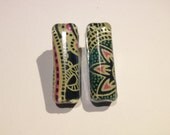
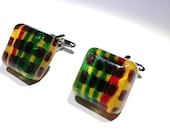
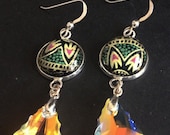
Lewa Jewel specializes in producing bold statement jewellery with a contemporary African influence. We spent some time speaking to the founder of Lewa Jewel, who explained to us the intricate and manual process of making these truly one-of-a-kind Lewa Jewel designs.

We found her work to reflect the time and effort she spends on each piece, as seen in the clean cut professional finishing of her jewellery. The fanciful patterns she creates using dyes, illustrates a special creative quality of Lewa Jewel that distinguishes her work from her competitors. This instantly captured our attention. Images below courtesy of the Lewa Jewel Etsy page.


Contact Info | Etsy: Lewa Jewel | Email: lewajewel@gmail.com

Kenza Accessories was founded in 2012. The company designs handbags, clutches, jewellery (earrings, rings, necklaces, bracelets and body chains), sunglasses, hats and scarves. They pride themselves in being able to offer a range different styles and trends to for women, ranging from contemporary, African and vintage designs.

Kenza Accessories showed off their jewellery collection at Africa Fashion Week London, which left us very impressed! Video below courtesy of the Kenza Accessories YouTube channel.


Contact Info | Twitter: @KENZAccessories | Facebook: Kenza Accessories | Website | Email: info@kenzaaccessories

Kiyana Wraps can best be described as 'head-wrapping artists'. We first heard about Kiyana Wraps through media coverage at 'Africa Fashion Week London 2012' and through various fashion blogs and websites.


It was thus a pleasant surprise when we stumbled across this stall to see Kiyana Wraps for ourselves! This company is clearly on a mission to make head-wrapping a fashionable art-form and head-wraps a complimentary accessory to any outfit. Video below courtesy of the Kiyana Wraps YouTube channel.


Contact Info | Twitter: @KiyanaWraps | Facebook: Kiyana Wraps | Website | Email: kiyanawrapsit@gmail.com


Cosmetics

SoTonye is a cosmetics company that specialises in using natural ingredients for skin and hair products. Their products are free from chemically-infused products, and pride themselves on using natural oils and fruits such as shea shalva, shea idonea, avocado oil, jojoba oil and coconut oil.

We loved the warm and sweet smelling scent of the So Tonye products and appreciate the abundance of information they provided about maintaining healthy hair and skin. Image below courtesy of the SoTonye website.


Contact Info | Twitter: @sotonye24 | Facebook: SoTonye Naturals | Website | Email: info@sotonye.co.uk

Click here for more upcoming events!


Image Source | Image courtesy of Africa Fashion Week London. All images are copyright of Yaaya unless otherwise stated.

Sunday, July 21, 2013

Yaaya At: Africa Writes 2013 | Perspectives on Contemporary African Writing

Africa Writes is an annual festival founded by the Royal African Society. It is a celebration of African literature, showcased through dynamic panel discussions concerning the African literary scene to book launches of well-established and emerging talented authors, from the African continent and its diaspora. Yaaya believes 'Africa Writes' is now arguably the UK's most successful and popular forum for Africans in the diaspora to access the latest contemporary African literature, hearing from the talented writers themselves speak about their work, and converse about a more diverse representation of stories being published about Africa. After following the live tweets from the first day of the festival, it was an understatement to say that Yaaya was excited about the various events lined up for the second day, on Saturday 6th July 2013 at The British Library.

Once seated amongst the buzz and the vibrant chatter, the auditorium was hushed to welcome the day's opening remarks before introducing the first session on 'African Writing Today'. This was a panel discussion chaired by the charismatic Chuma Nwokolo, the publisher and editor of African Writing Magazine. On the panel to speak were African writers Doreen Baingana (Uganda), Huchu Tendai (ZImbabwe) and Leila Abouela (Sudan). The audience were encouraged to imagine Chuma and his friends Doreen, Huchu and Leila were in his living room in Asaba (Delta State, Nigeria), to which the audience laughed. The discussion was contextualised as an exploration of the current patterns and directions of contemporary African writing and its future. And so this conversation began!

The first question tackled the phrase 'African Writing'. Chuma Nwokolo posed to the panel how long it would be before a profusion of African literature on the mainstream literary scene would make the category 'African Writing' needless, so much so that writing by African authors would be just that: writing. Doreen Baingana was interestingly ambivalent about the term 'African Writing' or 'African Writer' and instead proposed that "we should claim it and use it to our own purposes". She also emphasised the need for having more African critics reviewing literature to provide a better focus on the details of the stories rather than be preoccupied with the details of the label itself. Ultimately, it was up to the African writers and critics to own the term 'African writing' and re-define what it is, so that the label was not an umbrella term for the stereotypical narratives of Africa and its people.

For the next question concerning the future of African writing, Leila Abouela understandably couldn't predict how long 'African writing' would be around for. However, while drawing on her own experiences with the reception of her last novel 'Lyrics Alley', a story set in 1950s Sudan about the influential Abuzeid dynasty, she alluded to the timelessness of African stories and how its various narratives of the past still remained powerfully relevant, and could successfully cross the socio-geographic divides. For example, 'Lyrics Alley' was selected as book club choice for the Emirates festival in Dubai, where many Emirati women voiced that they could identify with the women in the novel through the themes of tradition versus modernity and oppressive patriarchies. Huchu Tendai echoed her point and summarised that the emergence of more diverse African narratives shared a range of different realities that could be sympathised with, and enjoyed by readers that weren't African. This was owing to thematic concepts concerning, for example, the suppression of women's rights not being a singularly African issue but instead an issue universally understood and experienced around the world.

The conversation delved into the widening breadth of innovative writing styles before landing on a topic that Yaaya immediately identified with, which was the growing prominence of women's writing and institutions created for bringing greater exposure to women writers. Doreen Baingana is the chairperson of the NGO Femrite - The Uganda Women Writers’ Association, which was founded in 1995 by then Makerere University lecturer and now Minister of Information and National Guidance for Uganda, Mary Karoro Okurut. She explained how Femrite created and facilitated many programs to develop and publish women writers in Uganda, and more recently in the whole of East African region. She described her passion about creating institutions that encourage African women writers. These were typically women who wouldn't have all the resources or financial support to work on honing their craft, go to residencies, or have time and space away from their families in order to write. She highlighted Monica Arac de Nyeko’s Caine Prize Award in 2007 for her short-story ‘Jambula Tree’ to credit the excellent networks of support and mentorship provided by Femrite.

The session, as did others during the day, concluded with an energetic round of applause from the audience. In between roaming the extensive international book market in the foyer, Yaaya attended many of the other events during the day in the Conference Centre. One of best moments included meeting rising star MÅ©koma wa NgÅ©gÄ©, author of crime-fiction novel 'Black Star Nairobi', and his father NgÅ©gÄ© wa Thiong’o, a renowned author, playwright and essayist.

Perhaps the most memorable moment was the tribute to the late great Chinua Achebe, a Nigerian professor and globally acclaimed novelist, poet, critic: the grandfather of contemporary African literature. There was a screening of a poignant short film that Richard Dowden, Director of the Royal African Society, filmed with Chinua Achebe, where Mr. Achebe spoke with sadness of his regret of being away from his ‘home’ (Africa) for too long. An elegy from author Chimamanda Ngozi Adichie read in Igbo was followed by moving speeches from young female writer Chibundu Onuzo (The Spider King’s Daughter) and Chuma Nwokolo. The tribute to Chinua Achebe was a celebratory remembrance of his life, works and achievements. It confirmed the special importance that will always be attached to his name by literary fans. These fans are not only those from the African continent and its diaspora, but also those millions of young and old readers from around the world.

Image Source | Image is copyright of Yaaya.

Yaaya At: Africa Writes 2013 | The Case For And Against 'Afropolitanism'

On July 7th 2013, Yaaya attended a talk entitled ‘Fantasy or Reality? Afropolitan Narratives of the 21st Century’, hosted by the Royal African Society as part of their programme of events for Africa Writes. Already familiar with the term Afropolitanism, and its increasing popularity to define a particular kind of ‘African’ and African experience, we wanted to discover if this relatively nebulous term held any weight.

Indeed, we entered the doors of the British Library’s conference centre armed with pre-conceived notions about this new ‘philosophy’, which seems to describe economically mobile, well-travelled, educated young Africans. You know, the type of African that may have been born and raised in a suburb in Nairobi, parties in Johannesburg to the sounds of Angolan House music, schooled at the London School of Economics for their undergraduate degree, holds an MBA from Columbia University in New York, and works in Berlin.

With an exciting panel of guests such as the highly esteemed Professor Paul Gilroy, acclaimed blogger and MsAfropolitan founder, Minna Salami, Journalist Nana Ocran and Visual Sociologist Dr Emma Dabiri, the case for and against Afropolitanism was made!

The Case for Afropolitanism - Minna Salami

  1. Afropolitanism is derived from the word ‘Africa’ and ‘Cosmopolitan’. Cosmopolitanism is linked to globalisation, which is not a new experience for Africa, as the continent has taken part in intercultural exchanges with different regions and nations for a millennia.

  2. Africa has not only lost out from these cultural exchanges, but have greatly benefited from them, which has enabled African citizens to play a huge role in shaping the world.

  3. Afropolitanism and Pan-Africanism are hugely complimentary. A younger sibling to Pan-Africanism, Afropolitanism has links to new technology, social media, contemporary arts, fashion etc. At its core, it’s about being enlightened about other parts of the continent, and the different experiences and lifestyles there, thus highlighting how the term embraces and describes a shared African citizenship.

  4. Afropolitanism is not a new identity, or a new kind of African, or a new way to be African. Rather, it’s a way to engage with Africa and the world simultaneously.

  5. It’s a philosophy about Africa and it’s citizens, for those that find themselves in the continent, or who have been forced to migrate willingly or unwillingly.

The Case Against Afropolitanism - Nana Ocran

  1. It’s relationship with Pan-africanism is tenuous, as it raises the questions “who is and who isn’t an Afropolitan?" and “Does it include those from the Caribbean diaspora?"

  2. It’s an urbanised term that seems to be associated with city life and experiences.

  3. Title’s feel reductive and assumptive, with Afropolitanism the term appears to hold a narrow definition.

The Case Against Afropolitanism - Dr Emma Dabiri

  1. Afropolitanism seems to sideline insights into race, modernity and identity, in favour of consumerist narratives about Africans and Africa.

  2. The term supports a compartmentalisation of society along lines of wealth instead of challenging it, as seen through the promotion and celebration of sex- in- the- city lifestyles, designer clothes, bags and shoes.

  3. It insinuates that the value of Africans and Africa is determined by our ability to reproduce Africanised versions of a western lifestyles e.g palm wine mojitos and OK magazine.

  4. The commodification of African culture that the term seems to reflect, is dangerous as it serves corporate interests, by placing the capitalism at the heart African culture. This appears to strengthen the commerce of blackness as seen with African - American culture.

  5. Afropolitanism arguably tries to challenge negative narratives about Africa and Africans. However it does this by privileging certain types of African experiences i.e successful, well - travelled and wealthy Africans, in a context where poverty millions still suffer from poverty, and where majority of Africans have not travelled to, or lived in the Western world.

  6. Afropolitanism has connotations of being ‘hip’ and progressive. However it is not clear whether these so called Afropolitans are concerned with consciously engaging with the world beyond their own social spheres, to issues that affect the vast majority of Africans.


For us, identity and experience is an important part of our work as we attempt to showcase and articulate the experiences of black women living in Europe. Naturally, identity, heritage, historical roots, and feelings of belonging, play a significant part in how a person defines themselves in a continent that represents another home. We haven’t yet heard anyone define themselves as an Afropolitan, however it certainly does speak to the experiences of those of some Africans, and their relationship and experiences with the different continents they have call home, despite its exclusive and commercially driven characteristics.

Image Source | Image is copyright of Yaaya.

Monday, June 03, 2013

Yaaya At: Africa @ Spitalfields | Home Interiors & Toys

Africa
@ Spitalfields

Africa @ Spitafields had a variety of home interior designers showcasing their work. Additionally, we loved the hand-made toys and dolls and how they captured the innocence and happiness of childhood in a way that identified with and celebrated African culture and heritage. Find out more below!

Home Interiors

Bespoke Binny makes home accessories such as cushions out of African textiles. We found her work (as well as her personality) to be bright, funky and cultural, adding exuberance to anyone’s living room.


Contact Info | Facebook: Bespoke Binny | Twitter: @BespokeBinny | Website

Happy Piece describes itself as being a company that uses business and design to empower women to rise above poverty, by producing and selling Rwandan woven baskets and bowls. We were captivated by the beautiful bowls made by the women they work with, and even more by the social entrepreneurial cause that underpins their operation.


Traditional hand-made Rwandan baskets have proven to be a hit in America. Last year saw popular U.S. department stores like Macy's and Anthropologie stocking them on their shelves.

Contact Info | Twitter: happypieceHQ | Facebook: Happy Piece | Website


Children's Toys

Dolls by Verona C makes hand-made dolls adorned in African-inspired textiles. They are cute, colourful, and cuddly, and would make a lovely present for any child.


Contact Info | Facebook: Dolls by Verona C

Yaaya thoroughly enjoyed speaking to all the vendors we have featured in our coverage of the Africa @ Spitalfields event, and we look forward to the next one.

Now, Yaaya would love to hear from you! Did you attend the event, if so - which stalls were your favourites? If you were a vendor at the event, please let us know more about your experience of sharing your passion and creativity with everyone.

See below for all our posts on the coverage of the following stalls at Africa @ Spitalfields 2013.

Part 1 : Yaaya At : Africa @ Spitalfields | Art

Part 2 : Yaaya At: Africa @ Spitalfields | Fashion & Skin Care and Beauty

Part 3 : Yaaya At: Africa @ Spitalfields | Home Interiors & Toys

Click here for more upcoming events!


Image Source | Spitalfields What's On Guide : Africa At Spitalfields
All other images are copyright of Yaaya.

Sunday, June 02, 2013

Yaaya At: Africa @ Spitalfields | Fashion & Skin Care and Beauty

Africa
@ Spitalfields

One of the first things that come to mind when one thinks of Africa is fashion. African textiles and jewellery have become increasingly popular, making its way into the stores of many Western retailers. Yaaya met some up-and-coming fashion and accessories designers, and discovered a lot of talent and creativity amongst them.

We also checked out some of the products at the skin care and beauty stalls that specialised in using natural ingredients only found in Africa.

Fashion

Ines Kitoko make African-inspired accessories. We found her hats in particular to be stylish statement pieces, and versatile enough to complement any outfit.


Contact Info | Facebook: Ines.Kitoko | Twitter: @__KITOKO__

Accessories Lots is a new label that specialises in leather belts and bags. We liked the quality of the leather, their matte finish and their lightweight feel.


Shifara Jewellery hand-make Ethiopian Jewellery, which we found absolutely stunning! The detail and craftsmanship, as well as the symbols and colours used in their pieces proudly displays Ethiopian culture.


Contact Info | Website


Skin Care and Beauty

Essence of Morocco produces natural beauty products made from Argan oil, which is extracted from the Argan tree that only grows in Morocco. It has various nutritive, cosmetic and medicinal properties, and is often used to: hydrate skin, improve skin elasticity, and improve the appearance of stretch marks and scars.


Contact Info | Website

Stay tuned for our last post in our coverage of the Africa @ Spitalfields event, Monday 3rd June, which features the home interiors and toys stalls.

Click here for more upcoming events!


Image Source | Spitalfields What's On Guide : Africa At Spitalfields
All other images are copyright of Yaaya.

Related Posts Plugin for WordPress, Blogger...