"I'm going to go to their offices, because whenever I hand out the CV nobody replies or they say ‘no’. So if I meet them face to face, I can blag my way in."

Toyin Owoseje | Proving Persistence Is The Key, Wrench and Bulldozer For Unlocking Opportunity’s Door

Feature Post Of The Week

In Her Words |

Principle 2:
The Beloved Community
is the framework for the future.

Dr. Martin Luther King, Jr |
Six Principles of Nonviolence

"

Food-For-Thought

social integration | soh-shuh l in-ti-grey-shuhn |
n.
"the blending and unifying of social groups, most commonly seen in the desegregation of races throughout history"

Yaaya asks:

To what extent do you feel social integration
for European black women has been achieved in the nation you live in?

?

Join The Conversation

Yaaya Asks About | Social integration for black women in Europe and for European black women globally

Thursday, May 09, 2013

Activist First, Academic Second

" I have been forced to distinguish between challenges and struggles. Challenges can motivate you.
But I find it
impossible to deal with struggles. "

Professor Cecile Wright is a woman who names and shames injustice. A staunch Labour Party supporter, she has spent the last 30 years advocating for black workers’ rights in the University and Colleges Union, and publishing books on social injustice and racial inequality.

In Part 2 of our 3-part interview, Cecile Wright shares with Yaaya the challenges she has faced, and her passion for politics.

Click here to read Part 1.

And so the conversation continues …

Yaaya:
You once described yourself as “an activist that happens to be an academic”. Can you share with Yaaya some examples of your activism?
Cecile W:
Today is illustrative of that political agenda. I am part of a delegation for the University and Colleges Union. I’ve been active within the Union for many years at a localised level but within the last 5 years, I’ve been elected twice to the National Executive Committee as the National Black Representative for academics in higher education (HE). That’s an example of my activism and political motivation.

As far back as I can remember, I have been involved in community based activities. I recall at the age of 16, chairing a meeting with the late Stokely Carmichael Kwame Ture, a great national figure that helped shape the agenda around civil rights, and the liberation of black people within the States in the ‘60s. Clearly, being there at the age of 16, with such a historical figure, it had a profound impact. So that’s an illustration of some of the activism I have been involved in.
Yaaya:
You are clearly passionate.
Cecile W:
(laughs) Yes, everyone says I come across as quite a passionate person.
Yaaya:
And that is a great thing! It is obvious in your life’s work that you have put your money where your mouth is, and Yaaya respects that. You have faced many challenges along your journey, yet within you is an inherent self-assuredness. Has this been key to enabling you manoeuvre the challenges?
Cecile W:
Clearly there is a degree of steel within me. I think it is a sense of determination. Perhaps the affirmation that I received at appropriate times has assisted me in countering the challenges. (pauses) I have had the privilege of a strong matriarchal family experience. My mother’s half-sisters were extremely strong and successful women, and always quite affirming and positive in their support of me.
Yaaya:
How have these challenges shaped you as an individual?
Cecile W:
One thing I do know, is that I am not a bitter person. (pauses) I tend to border on being too optimistic and sometimes, quite naïve. I think ‘well, that has happened to me; I’ll dust myself down, and start again’. That’s not to say that I don’t feel pain.

I have been quite lucky to have significant others (family and friends) who have been supportive during times of doubt and crisis. Challenges haven’t made me bitter, nor dampened (totally) my optimism and enthusiasm, spirit and passion. I have been forced to distinguish between challenges and struggles. Challenges can motivate you. But I find it impossible to deal with struggles.

(Silence)

However, there is happiness in my life! (laughs) Let me tell you what I see as my achievements. I gave birth to two beautiful boys. The first, Timothy, is 22, and an exceptionally bright young man. Nice personality, charismatic, looks like Obama (laughs) He works in Nottingham at a school, mentoring young students who want to go to Oxbridge, and assisting me on research projects. My second son, Thomas, is 17, and doing his A-Levels. He is hoping to study politics at Liverpool University because of its history and connection with slavery.

Those are my achievements. And they love me to bits. (pauses) That’s my family life. Great. And supportive. Without that, I think it would be very difficult for black women to navigate spheres of society that we are ‘not supposed to be in’. You have to get that (family) right. Safe, supportive, and unconditional.

In the final part of our conversation, Yaaya and Cecile Wright explore the challenges facing black female academics in Higher Education. Look out for Part 3 on Saturday 11th May 2013.

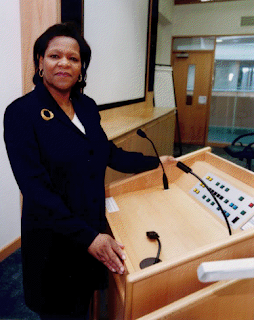
Tuesday, May 07, 2013

Cecile Wright, The Woman Behind The Wonder

Of 14,000 Professors in the UK, only 10 are black and female. Of these, Cecile Wright is the only one in the Humanities and Social Sciences.

Born in Jamaica, she spent her childhood in early ‘60s England, at a time when scientific racism flourished, and David Pitt fought for equality at the House of Lords. In many ways, Cecile’s chosen discipline (Sociology) speaks deeply to her own personal experience of social injustice and racial inequality.

In Part 1 of our 3-part interview, Yaaya discovers the woman that is Cecile Wright; her prolific success as a Professor and an author, and her struggle to aspire to the very heights of academia.

And so the conversation begins …

Yaaya:
Cecile, Yaaya is delighted to meet with you! What influenced you to agree to be interviewed?
Cecile W:
Thank you for the invitation! I am aware that there are narratives about black women, but those narratives tend to perpetuate stereotypical images. We don’t get the breadth of what black women within the UK are doing, and the contributions that they are making. So where there is an opportunity and the space to present one’s life story, I am happy to do so. It’s about adding to a more all-embracing record of black women within the UK.
Yaaya:
Your professional profile is very impressive. You have undertaken PhD examinations at some of the world’s most prestigious institutions (Cambridge). You have published research and authored books. But, who is the ‘woman behind the wonder’? Behind all of this, who is Cecile Wright?
Cecile W:
In my mid-50s, I am beginning to ask myself “Who am I” (pauses). I have been motivated throughout my life by issues of social justice and inequality. Issues around opportunities as they have been denied through education; and issues around wider social exclusion, through being trapped in disadvantaged, poverty-ridden situations, because of circumstance.

And attempting, through my work, to give a voice to people who experience those unfortunate situations. What I found is that people have aspirations and dreams, and given the opportunity to realise them, things could transform...

Ultimately, I am a political animal, who has used the space that I have been given to try and realise some of my passionate concerns around equality and injustice.
Yaaya:
Why pursue what might be perceived as a docile career (academia), and not politics?
Cecile W:
In my mid-50s, I am thinking of going into politics. It has taken me nearly 30 years. Why? (pauses) I didn’t know how to. I didn’t have the confidence, the social network, or the hand-holding. Nobody told me, as a black woman, that I could go into politics. And I was waiting to be told. Nobody told me I could be a university professor. Nobody told me I could be a successful academic. A lot of the things that I have done throughout my life have been happenstance. I have been waiting to be told I could do it. I don’t know why. But I am not (waiting) anymore.
Yaaya:
You have had a successful career. Why do you think that is?
Cecile W:
I don’t see it as a successful career. I have done things to a degree that I felt I could do, but I still feel that many of them have happened by chance. I haven’t sat down and planned a career. These things happened because they’ve been situations that I’ve been passionate about. I have been a member of the Labour Party since I was 18. Had someone said to me at 25 ‘have you ever thought of politics?’, I probably would have been in politics. It has taken me nearly 30 years to realise that I have been in the wrong place.
Yaaya:
Let us go back to the 25 year old Cecile. Why did you feel that, as a black woman, you could not go into politics?
Cecile W:
In the same way that I thought as a black woman, I couldn’t get A-levels, go to university, get a PhD, an academic post in the university, or become a Professor.
Yaaya:
Yet you have done all these things?
Cecile W:
Yes! Perhaps my attitude is to pick challenges and overcome them. Perhaps I’ve been pushing the boundaries all along. Throughout most of my formative years, I’ve been in situations where I’ve been the odd one or two. Grossly, grossly isolated (pauses) and having my being, existence, ability and potential challenged.

Throughout my academic career, I have had the ‘right to be there’ challenged. (pauses) Outside of my immediate circle, I won’t have had wider, affirmative images around me in society that tell me ‘there is scope for you’. And that hasn’t stopped. Being a professor has been a non-stop struggle. It’s very challenging being a capable and able black woman with aspirations. I have no self-doubts regarding my ability, but it has been hard not to doubt.
Yaaya:
Look back across 30 years. What’s been the best thing about being a Professor?
Cecile W:
What is intriguing is how white colleagues see me as incongruous: a black woman who is also a Professor. But that’s just in the UK, not in the States. My name is often confused with Cecil, the male version. I am often mistaken for a white man. So I get invited to events, and this black woman turns up! (laughs) I have gone out of my way to attract black students to do Masters or PhDs where I can. I am really pleased that I have had the pleasure and the privilege of being a part of their lives, and of assisting them to realise their potential.
Yaaya:
What do you do to relax, when you are not teaching, publishing research or authoring books?
Cecile W:
I try to go to the gym 3 times a week and on 2 occasions, I do yoga.

Look out for Part 2 of our 3-part conversation on Thursday 9th May 2013, where Cecile Wright discusses her life challenges, passions, and political activism.

And So The Conversation Begins ...

Yaaya was founded out of a social necessity for black girls and women in 21st century Europe to share their own personal stories. These are real-life stories of game-changing triumphs, determined endeavours, and the highs and lows of unexpected self-discoveries.

There are monologues of concern about the lack of recognition of black female icons and leaders (not the lack of black female role models), and the oversimplification of a population of black females to a point where they become socially invisible. It is time for all of us to help bring together these individual discussion threads.

Today, everyone is being invited to come and sit at the table: to challenge,and transform perceptions by discussing the achievements, aspirations, ambitions of black girls and women in Europe; to delve deeper into a constructive dialogue where issues of negative stereotyping and social invisibility can be addressed collectively.

And so the conversation begins …

Anon:
To quote Shakespeare, “What’s in a name?”
Yaaya:
(smiles) We thought you might ask that. Yaaya is derived from the Ghanaian name “Yaa” - pronounced “Yah”. It is the name of a woman or girl of the Ashanti ethnic group, who is born on Thursday. It is also the name of one of Africa’s fiercest female warriors called Yaa Asantewaa. She was Queen Mother of Ejisu in the Ashanti Empire, and famously led the Ashanti rebellion known as “The War of the Golden Stool” against British colonialism in 1900.
Anon:
So is Yaaya the modern day “Yaa Asantewaa”?
Yaaya:
Well, it is often said that your name births the qualities of your character. For us, Yaa Asantewaa personifies Yaaya. She represents a strong and supportive, fierce and fearless, confident and courageous woman who boldly addressed injustice and led a nation to reclaim its identity. We, the Founders, hope that Yaaya will give influence and a voice to black girls and women in Europe.
Anon:
A voice?
Yaaya:
Yes, a voice to call together a community to help each other raise aspirations, confidence, and mentor ambitions in a positive way. For us, we want talk to motivate action … and action to motivate more talk. (Reflective pause). We want to create a forum in Europe for black females from a wide spectrum of backgrounds and experiences to talk about their everyday realities. Then from here, help build strong interconnected networks and support systems. Everyone believing in the need for such an initiative is definitely encouraged to participate!
Anon:
Are these black girls and women you mention who you collectively refer to as “those” in your motto?
Yaaya:
Yes. And No. So yes, “Those who have, those who are, and those who will” is intended to speak to our belief in black girls and women of the past, present and future generations to inspire, aspire and be catalysts for social change. But as mentioned before, this initiative requires a community to affect the effect we want and need. Our motto also speaks to those who have supported, are supporting and hopefully will support the social visibility and the recognition of positive images of black girls and women.
Anon:
The stories that will be told – are they just about black girls and women sharing their career successes, or are they more than that?
Yaaya:
Human beings are complex. If Yaaya was only focusing on career successes, we’d be telling one story. Apart from that one story being incomplete and inaccurate, it’s dangerous.
Anon:
Ah – as Chimamanda Adichie’s explained in “The Danger of a Single Story”.
Yaaya:
Exactly! We want to help tell and in turn help shape as many stories as possible. To tell only one side would be oversimplifying a person’s identity, struggles and triumphs. That’s how perceptions of a people become … “blurred”, and that’s how people become socially invisible. Attained success is as good a life lesson as unattained success - everyone’s path in life is different and is definitely a journey we can all learn and find motivation from.
Anon:
I see. So I guess for me, Yaaya represents … a platform to inspire ambition and celebrate achievement; to foster dialogue and tackle issues of social invisibility of black girls and women; and to promote fairer and positive images of black girls and women.
Yaaya:
That was very nicely put; those are our principles.

Related Posts Plugin for WordPress, Blogger...